So you want to design your own personal longboard, but you have no idea how. Well, here is almost ten years of
design experience boiled down to easily digestible pieces. The chart below outlines the most important board
attributes, and how they affect how your board rides. Below that is a glossary of terms and a explanation of
longboard lingo.
Performance Chart
BOARD
ATTRIBUTES |
Shorter Wheelbase |
Longer Wheelbase |
| Less Wide Trucks |
Wider Trucks |
| Softer Bushings |
Stiffer Bushings |
| Shorter/Less Wide Wheels |
Taller/Wider Wheels |
| Harder Wheels |
Softer Wheels |
| Taller Deckheight |
Shorter Deckheight |
|
RESULTING
BOARD
BEHAVIOR |
more responsive
smaller turning radius
better acceleration
slower overall
lighter
less stable at high speeds
|
less responsive
larger turning radius
worse acceleration
faster overall
heavier
more stable at high speeds
|
Glossary
ABEC rating
skate bearings are rated under the ABEC system. they are rated with a number from 1 to 9,
with the higher number assigned to bearings manufactured against a higher standard of precision.
The higher the number, the more finely made the bearing, resulting in it being more expensive.
bearings
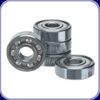 |
every skateboard needs eight bearings, two for each wheel. bearings really vary in price, which
is directly correlated to quality. bearings are rated on a system called ABEC.
|
bushings
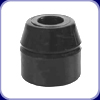 |
bushings are the small rubber part that sits in between the hanger and the baseplate of each truck.
bushings come in different stiffnesses. bushings are included
with the truck when you buy them, but usually you can't specify what hardness you
want. you can buy bushings on their own, and change them out. bushing hardness is measured
in durometer.
|
camber
in general, camber is any concavity or convexity of a surface. in skating terms,
it refers to the curvature of the board across the width of the deck. having
the deck raised at your toes and heels makes turning easier for the rider.
deck
the deck of a skateboard is the thin wooden part that you stand on.
deckheight
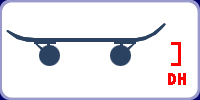 |
deckheight is the measurement from the ground to the top of the deck. this is determined by
taking the radius of your wheels, how tall your trucks are, and how thick your deck is.
|
decklength
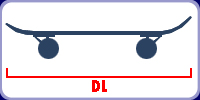 |
decklength is how long the deck measures from nose to tail.
|
durometer rating
durometer is the hardness rating that bushings and wheels are measured in. a wheel's durometer
is measured on the A-scale, with 74A being a very soft wheel and 95A being a very hard wheel.
bushings are not usually given an exact durometer rating, but rather, a soft/med/hard rating.
grip tape
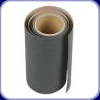 |
grip tape is usually just like a high tech black sandpaper with an adhesive back. grip tape can
be bought alone, as it wears away after some years of regular use. some companies actually use
a spray-on grip.
|
risers
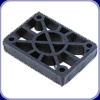 |
risers are a small piece of plastic or rubber that get bolted in between the baseplate of the truck
and the deck. they raise the deckheight, and help avoid wheelbite. angled risers
can also be bought to adjust the steering dynamics of the truck.
|
shape
shape is the combination of three components: the outline, camber, and kick nose/tail of your deck.
trucks
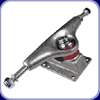 |
a truck is the multi-component metal part that attaches the wheels to the deck. a truck consists of an axle,
hanger, baseplate, bushings and a kingpin. the axle is the longest part of the truck, which has
treaded ends on it to secure the wheel in place with an axle nut. the hanger is the piece that
houses the axle. the kingpin and bushings attach the hanger to the baseplate, and allow the two to move
somewhat independently of eachother.
|
wheels
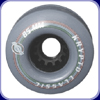 |
there are usually two components of wheels that need consideration: the diameter and the
hardness. diameter is measured in millimeters. longboard wheels are larger than usual wheels
and they usually range from 60mm to 85mm. hardness is measured in durometers.
|
Wheelbase
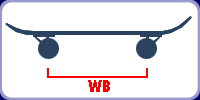 |
the wheelbase of a skateboard is the distance in between the front and rear axles of the
trucks. also the distance between where the front wheels touch the ground to where the
back wheels touch the ground.
|
Wheelbite
when the rider of a board steers hard one way or the other, it is possible for the deck to achieve such
a downward angle that it touches the inside wheel. in extreme cases, this stops the wheel from turning,
and can stop the entire board from moving (usually launching the rider forward). wheelbite can be avoided
with risers, that keep the deck away from the wheels. wheelbite can also be avoided by altering the deck
itself with wheelbite notches that remove the wood from where the wheels would touch in extreme turns.

|